
When you or someone close to you is looking for rehabilitation in Australia, one of the first questions is often whether to choose a public service or a private rehabilitation centre. Both options can provide valuable support, but they can differ in areas such as access, cost, treatment environment, privacy, accommodation and the level of personalisation available.
There is no single rehabilitation option that is right for everyone. The most suitable choice depends on your circumstances, the type of support you need, your health, your personal preferences and whether residential treatment is appropriate.
For people looking for a private and highly personalised recovery experience in Western Australia, Six Seasons Recovery offers a different approach. Located in the Margaret River region, the retreat provides a private setting where clients can step away from their usual environment and focus on their physical health, mental wellbeing and long-term recovery.
Understanding Public Rehabilitation in Australia
Publicly funded alcohol and other drug services play an important role in Australia’s healthcare system. In 2024–25, around 127,800 people received publicly funded alcohol and other drug treatment or support across Australia, through 1,316 publicly funded treatment agencies. These services include counselling, withdrawal management, rehabilitation, support and case management, and other forms of treatment.
Publicly funded treatment is delivered through a combination of government and non-government organisations. Treatment can be provided in community settings, outpatient services and residential facilities. In 2024–25, 68% of publicly funded AOD treatment episodes were delivered in non-residential settings, while 15% were delivered in residential settings.
For many people, public services can provide an important and accessible pathway into treatment, particularly for people who may not be in a position to fund private rehabilitation.
In Western Australia, publicly funded AOD treatment is also provided through a large network of services. In 2024–25, 127 publicly funded AOD treatment agencies in WA provided more than 20,000 treatment episodes to 14,773 clients.
What Is Private Rehabilitation?
Private rehabilitation is generally paid for by the individual, family, private health insurance or another funding arrangement, depending on the service. Private treatment centres set their own fees and the cost can vary considerably depending on the programme and facilities provided.
The main difference is not simply that private rehabilitation is more expensive. For some people, the value comes from having access to a particular type of environment, greater privacy, personalised treatment and residential support designed around their individual circumstances.
This can be particularly important for people who want to step away from their normal surroundings and dedicate a period of time specifically to recovery.
Private Rehab vs Public Rehabilitation: What Is the Difference?
The biggest difference can often be found in the treatment environment and level of personalisation, rather than whether one approach is inherently better than the other.
Publicly funded services provide a broad range of treatment options and are an important part of Australia’s AOD treatment system. Private rehabilitation can provide an alternative for people who are looking for a more private residential experience and are able to fund that treatment.
Private facilities may also offer different accommodation arrangements, smaller client numbers and additional wellbeing services. However, what is included varies between providers, so it is important to look carefully at what a particular rehabilitation centre actually provides rather than choosing based only on the word “private” or “luxury”.
Why Privacy Can Matter During Recovery
For some people, privacy is one of the most important considerations when choosing rehabilitation.
Addiction and mental health challenges can be deeply personal. A person may be worried about colleagues, clients, friends or other people knowing that they are receiving treatment. They may also simply feel more comfortable discussing difficult experiences in a private environment.
At Six Seasons Recovery, privacy is built into the residential experience. The retreat has a maximum of four guests at a time, with private rooms and bathrooms. The treatment approach is centred around individual support rather than requiring clients to participate in group therapy.
This smaller environment allows clients to have space to concentrate on their own recovery without being surrounded by a large residential group.
Personalised Treatment at Six Seasons Recovery
One of the central ideas behind Six Seasons Recovery is that recovery should be built around the individual.
Every person’s story is different. Someone may be experiencing substance dependency alongside trauma, anxiety, depression, relationship difficulties or work-related stress. Another person may primarily need support with their mental health and wellbeing.
Six Seasons offers three key areas of support: Recovery & Wellbeing, Mental Health and Substance Addiction. Each programme is designed around the person’s circumstances, needs and goals.
The approach combines personalised therapies with physical wellbeing, nutrition and emotional support. Rather than treating recovery as a single issue, the programme looks at the different areas of life that can influence long-term wellbeing.
A Holistic Approach to Recovery
Rehabilitation is not only about stopping substance use. For many people, sustainable recovery also involves understanding what contributed to their difficulties and developing healthier ways of managing life.
Six Seasons Recovery’s holistic approach brings together psychological support, physical wellbeing, nutrition and emotional care. The tranquil Margaret River setting provides an opportunity to step away from everyday distractions and spend time reflecting on the changes needed for a healthier future.
The aim is to help clients develop practical habits and greater resilience that can continue after they leave the retreat.
A Private Residential Setting
One of the biggest differences between community-based treatment and residential rehabilitation is the opportunity to temporarily step away from your usual environment.
For someone dealing with ongoing triggers, stressful relationships, demanding work or an unhealthy routine, remaining in the same environment while trying to make significant changes can be challenging.
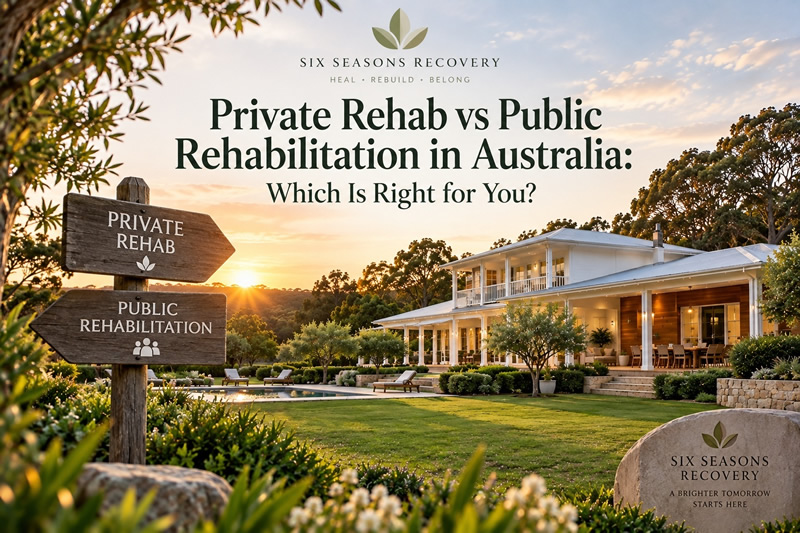
Six Seasons Recovery provides a private residential setting in the Margaret River region of Western Australia. The retreat offers private accommodation, personalised treatment and a peaceful natural environment where clients can focus on their recovery.
Private transfers can also be arranged from Perth or Busselton, helping clients make the transition to the retreat in a discreet and comfortable way.
Treatment for Substance Addiction and Mental Health
Six Seasons Recovery is not focused solely on one type of addiction. Its substance addiction programme can support people experiencing difficulties with alcohol, illicit drugs and prescription medication dependence.
The retreat also provides mental health support for a range of challenges. This means the treatment approach can consider the relationship between substance use, emotional wellbeing and other personal difficulties when relevant to the individual.
This broader approach can be valuable because recovery does not always fit neatly into one category. A person’s substance use may be connected with stress, trauma, anxiety, depression or other challenges that also need attention.
What About Detox and Medical Support?
Detoxification and rehabilitation are not necessarily the same thing.
Some people require medically supervised withdrawal management before or as part of their broader recovery plan. Australian Government data shows that withdrawal management accounted for 8.6% of publicly funded AOD treatment episodes in 2024–25, with alcohol being the principal drug of concern in 56% of those episodes.
The need for detox and the appropriate level of medical support depends on the individual. Anyone who may be physically dependent on alcohol or certain drugs should seek professional medical advice rather than attempting to stop suddenly without appropriate support.
At Six Seasons Recovery, health and medical needs are considered as part of the initial assessment and individual treatment planning. The focus is on creating an appropriate programme based on the person’s circumstances rather than assuming that everyone requires the same pathway.
Why the Environment Can Make a Difference
The environment in which recovery takes place can be important.
A busy treatment centre may suit some people, while others may benefit from a quieter and more private setting. At Six Seasons Recovery, the retreat is surrounded by the natural beauty of Margaret River, providing a peaceful environment away from the pressures of everyday life.
The property, private accommodation, nutrition, physical wellbeing activities and personalised therapeutic support are designed to work together. The goal is not simply to provide luxury accommodation, but to create an environment where clients can focus on their recovery without unnecessary distractions.
Recovery Does Not End When Residential Treatment Finishes
One of the most important things to consider when comparing rehabilitation options is what happens after treatment.
Completing a residential programme is only one stage of recovery. Returning to work, family responsibilities and normal routines can bring new challenges, which is why continuing support can be important.
Six Seasons Recovery provides 12 months of aftercare as part of its programmes. This gives clients ongoing support after their residential stay and helps them continue working on the changes developed during treatment.
For someone considering private rehabilitation, this longer-term approach can be an important part of the decision.
Which Option Is Right for You?
There is no universal answer to whether public or private rehabilitation is right for a particular person.
Publicly funded services provide essential treatment and support for thousands of Australians every year and can offer a range of counselling, withdrawal management, rehabilitation and community-based services.
Private rehabilitation may be worth considering if you are specifically looking for a private residential setting, personalised treatment, greater privacy and a more individualised recovery experience and are able to fund private treatment.
For people looking for a private rehabilitation experience in Western Australia, Six Seasons Recovery offers a small, peaceful retreat in the Margaret River region. Its programmes bring together personalised therapy, mental health support, physical wellbeing, nutrition and continuing aftercare in an environment designed around the individual.
Ultimately, choosing rehabilitation is about finding a service that is appropriate for your needs, health and circumstances. Before making a decision, it is worth asking about the treatment approach, medical support, accommodation, privacy, programme length, costs and what continuing care is available after the residential programme.
A Private Path to Recovery
At Six Seasons Recovery, the philosophy is simple: recovery should be personal.
Your circumstances, your history and your goals are different from anyone else’s. That is why the retreat focuses on tailored programmes rather than a one-size-fits-all approach. Whether you are seeking support for substance addiction, mental health or overall wellbeing, Six Seasons provides a private environment where you can step away from everyday pressures, work with an experienced team and focus on building healthier habits for the future.
If you are considering private rehab in Perth or Western Australia, Six Seasons Recovery can help you understand whether its residential programmes are suitable for your circumstances and what the next step could look like.
I’m Ready to Heal → Six Seasons Recovery – Get Started